In Ch2 many antichrists had gone out from the believers, denying that Jesus was/is the Christ. Now in Ch4 John is going to address false prophets. This is from the back drop of Ch3v24 which speaks of how we know that He abides in us out of the spirit that He give-a to us. John then finishes the subject of ‘spirits and false prophets’ in Ch4v6 with the spirit of truth. Within Ch4v1-6 John sets out 3 tests to determine the spirit of the truth versus the spirit of the error.
Background to the Gnostics:
- There were many groups after the time of Jesus who followed Him but had very different understandings and beliefs;
- Many of the groups believed that Jesus Christ was Divine but they did not believe in His humanity;
- One belief was that a man named Jesus was born and at his baptism the Divine Christ came upon Him and taught many great things but before the crucifixion, the Christ left the man Jesus;
- Another belief was that Jesus Christ was like a phantom;
- Underpinning philosophy was that the material was evil and so the Divine would not inhabit a human body;
- They believed in a greater spiritual ‘knowledge’, hence the name ‘Gnostics’, to save them not in the sacrifice of the Godman Jesus Christ.
1 Beloved, Abelieve not every spirit but Atest the spirits, if it is out of (the) God, because many false prophets have Agone out into the world.
In the New Testament ‘spirit’ can refer to any one of the following:
- The spirit of the man;
- The spirit of the God;
- The spirit of the Christ;
- spirit of God;
- spirit of Christ;
- The Holy Spirit;
- holy spirit;
- Angel;
- Fallen angel/evil spirit.
There are 2 types of prophecy:
- Foretelling the future;
- Forthtelling (edification, exhortation and comfort).
These false prophets were once part of the early ‘orthodox’ church (not to be confused with the Orthodox church today), but then left to join another group(s).
1st test:
2 In this, yous know1 the spirit of (the) God: every spirit that Aconfesses Jesus Christ, having Acome in flesh, is out of (the) God;
3 and every spirit that confesses not (the) Jesus Christ, having Acome in flesh, is not out of (the) God and this is the one of the antichrist, which yous have Aheard that MDorPDcomes and now is already in the world.
- 1st test – did Jesus Christ have a physical human body?
- This is what many of the Gnostic groups denied;
- False prophets who were part of these Gnostic groups, influenced by their own spirits or the spirit of the antichrist denied this fact;
- Not so much a problem today within Christendom but in John’s day this was a massive problem.
4 Yous are out of (the) God, little children, and have Aovercome them because the one in yous is greater than the one in the world.
- I have always been taught and known this verse to mean that the Holy Spirit in you is greater than any spirit in the world;
- This is a true statement (although I would leave out the definite article) but this is not what the verse is saying;
- Who is the ‘them’? – false prophets or the spirits?
- Who is ‘the one’ in this verse?
- Colour coding for previous verses (blue=masculine, pink=feminine and green=neuter):

- ‘them’ in verse 4 is masculine plural and so must refer to the false prophets as this is the only previous plural masculine noun.
- ‘the one’ in verse 4 is masculine so must be replacing a masculine noun;
- ‘spirit’ is neuter so grammatically John is not speaking about the Holy Spirit;
- ‘the one’ must refer to God, prophet, Jesus Christ, antichrist or world;
- Also, ‘in yous’ can mean 2 different things depending on context:

- ‘In yous’ can refer to being in individuals or among individuals;
- See also 1 Peter 5v1 – among yous rather than in yous – same Greek phrase;
- I would lean towards ‘the one’ being the prophet among yous for the following reasons:
- World does not fit in the verse;
- God and antichrist are not subject nouns in the passage;
- The noun ‘spirit’ is the focus i.e. out of the (God), the spirit of (the) God or the spirit of the antichrist;
- The other main noun is prophet;
- It follows that ‘the one’ after ‘them’ is the same type of noun i.e. prophet;
- The noun ‘prophet’ can be consistently used in both instances for ‘the one’ in verse 4 as the comparison for one greater than the other.
Why is this so well known as ‘the Spirit in yous’?
- 2 early writers who commented on this verse – Augustine (knew some Greek but not fluent), Cyprian (knew no Greek);
- Latin word for spirit – ‘spiritus’ is a masculine noun;
- When the Greek was translated into Latin, the word for ‘spirit’ changed its gender from ‘neuter’ to ‘masculine’ and therefore a different interpretation was arrived at. This however was not what the original author John meant.
2nd Test:
5 They are out of the world. On account of this, they Aspeak out of the world and the world Ahears them.
- 2nd test – Do they speak out of the world?
- Many Christian messages are designed to bring a worldly comfort but are not scriptural:
- Supposing that gain is godliness (1 Tim 6v5);
- Itching ears – heap up for themselves their own teachers (2 Tim 4v3);
- Some Christian denominations like the word of faith movements, health, wealth and prosperity churches promote such things.
3rd Test:
6 We are out of (the) God. The one Aknowing1 (the) God Ahears us. He who is not out of (the) God, Ahears us not. Out of this, we Aknow1 the spirit of the truth and the spirit of the error.
- ‘The one’ may again refer to the prophet knowing God;
- ‘Hears us’ – the apostles;
- Does the prophet hear what the apostles have said?
- Today we cannot hear the apostles directly but we have their words recorded in the NT;
- 3rd test – does what is being said agree with the apostles’ doctrine (Acts 2v42)?
- A prophet/prophecy should be in agreement with the apostles’ doctrine.
Summary of 3 tests:
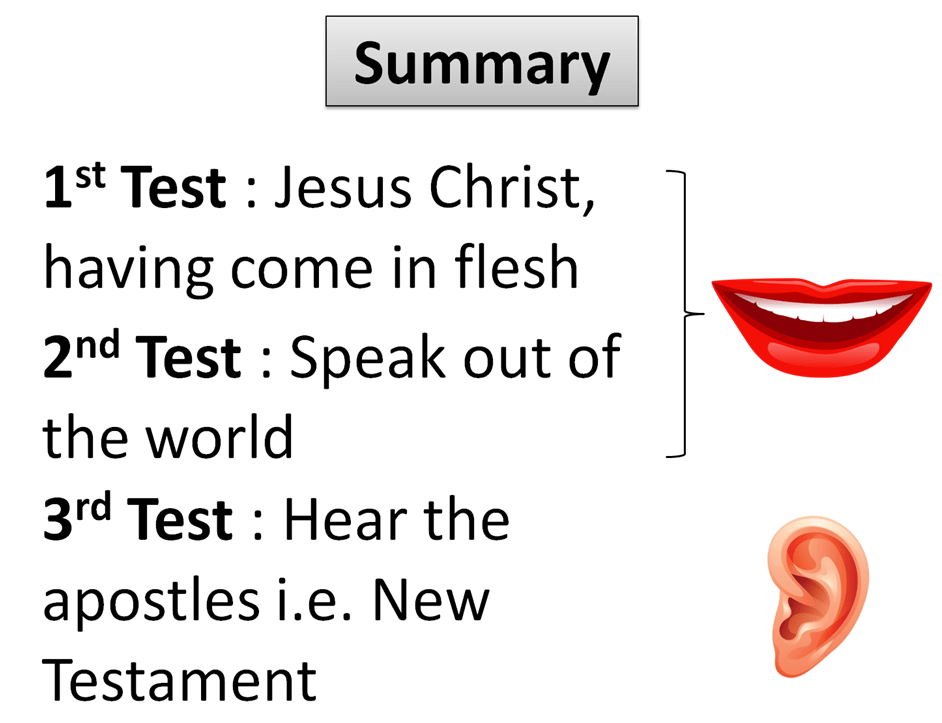
Out of this or from these 3 tests we can determine the spirit of the truth (the Holy Spirit) and the spirit of the error.
 Born2Vision