7 Little children, let no one Alead yous astray; the one Adoing the righteousness Ais righteous, according as that one is righteous.
8 The one Adoing the sin is out of the devil because from beginning the devil Asins. Into this the son of (the) God Pmanifest-a, that he might Aloose-a the deeds of the devil.
Contrast:
The one doing the righteousness (law of Christ)
vs
The one doing the sin (sin nature)
The devil wants us to sin so we become disqualified for inheriting the kingdom of the heavens. But because of the manifestation of Jesus, His death and resurrection we have the power through holy spirit to overcome our sin nature and hence our sin.
9 Every(the)one having been MorPborn out of (the) God, Adoes not sin because seed of him Aabides in him and he is not MorPable to Asin because he has been MorPborn out of (the) God.
How do we reconcile this verse with 1 John 1v10?
- Born out of God/born from above is a onetime event in the past but is also a repeated, continuous process.
Why?
1. Grammar – aorist tense
John 3v3:
(The) Jesus MDanswer-a and Asay-2a to him, “Amen, amen, I Asay to you if not anyone (might) be Pborn-a from above he is not MDorPDable to Asee-2a the kingdom of (the) God.
1 John 5v18:
We have Aknown3 that every(the)one, having been MorPborn out of (the) God, Asins not but the one Pbeing born-a out of (the) God Akeeps himself and the evil one Mtouches him not.
In both of these verses notice that ‘born’ is in the aorist tense meaning it is undefined as to when the action occurs. 1 John 5v18 is a participle (being) in the aorist which implies a continuing or progressive action, not a onetime event in the past.
2. Picture of OT priests
Exodus 30v17-21: The priests had their bodies washed when they were first consecrated as a priest but afterwards they needed further washings or one could say further regenerations so they could minister at the altar and in the tabernacle. These further washings only needed to be their hands and feet.
3. Washing of the disciples feet
In John 13 Peter objected to Jesus washing his feet. However, when Jesus told him he would have no part with Him unless Peter let Him, Peter response was to wash all of him. Jesus responded by saying he only needed his feet washed. This is a practical example of servant hood but also a spiritual picture for us of the further washings required to have a part with Jesus i.e. to be His bride.
What does seed in verse 9 refer to?
How is seed used in other New Testament passages?
- Literal seed
- Word of the kingdom
- Sons of kingdom
- Christ
- Word of God
- Offspring/descendants
It cannot be referring to a literal seed or to the sons of the kingdom. Both of these would not make any sense in the verse. The ‘word’ abiding in us or ‘Christ’ abiding in us would appear the most sensible interpretations.
10 In this, the children of (the) God and the children of the devil are manifest: every(the)one not Adoing righteousness is not out of (the) God and the one not Aloving the brother of him,
2 ways to tell that a believer is not born out of God at a point in time:
- Not doing righteousness (this would also apply to an unbeliever);
- Not loving his brother.
The following diagrams show the mother, father and child in relation to a believer born under the New Covenant and the Old Covenant. The 3rd diagram shows what happens when a believer sins.

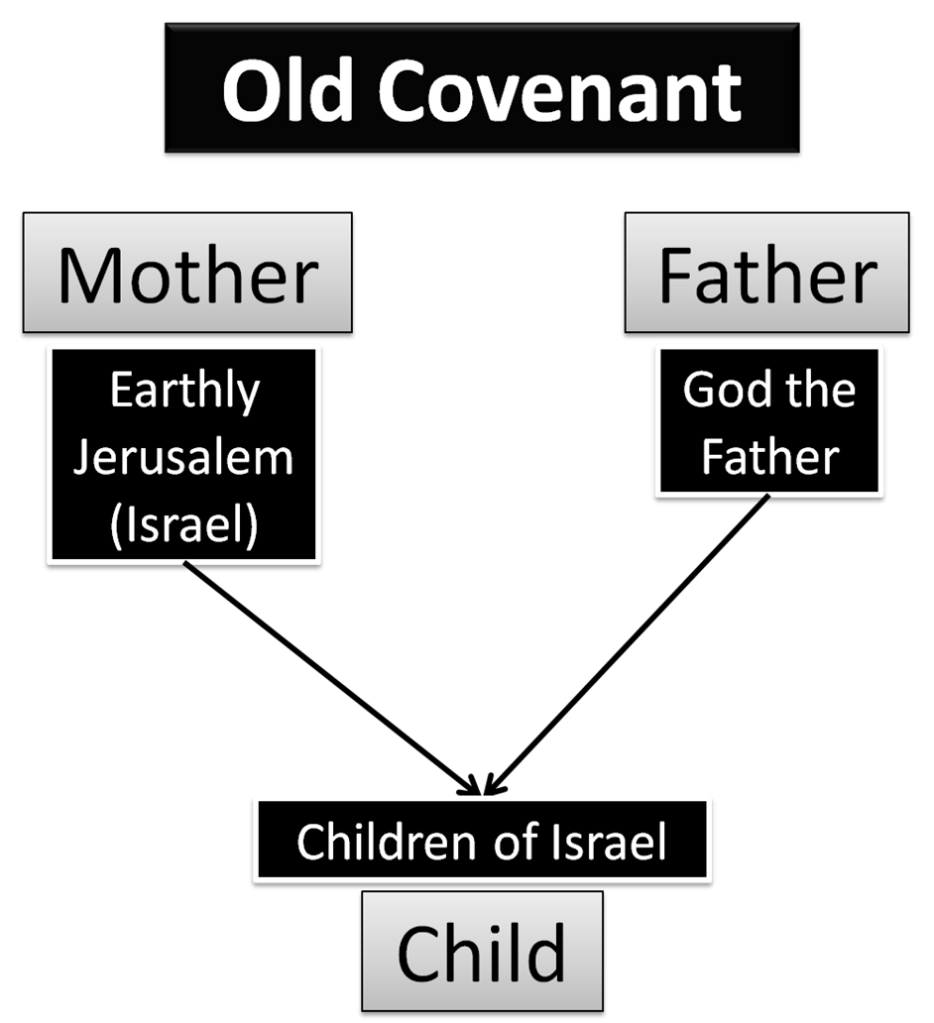

When you sin you are then a child of the Devil. You do not lose your past salvation, you are still a Christian but you must be born from above/born out of God again.
In v9 a simple present verb is used for does not sin. In v8&10 present continuous/progressive verbs are used to describe being out of the Devil and not being born out of God. The present continuous/progressive verbs have led many commentators to conclude that it is practising sin which John is referring to and therefore someone who is truly born out of God will not practise sin. This leads to a number of problems:
- How do we define practise? How many times or how long? 2 or more times? 1 day, 1 month or 1 year?
- Experientially, believers can struggle with certain sins for periods of time – this does not mean they have never been born out of God;
- Whilst practising sin may well be valid, it does not deal with the fact that v9 states ‘is not able to sin’ with no further qualification for the person born out of God.
It is better to re-examine how we interpret the concept of being born from above/born out of God rather than defining what the continuous verb would mean. All sin, no matter how many times or for how long breaks our fellowship with God and we must be saved again through the washing of regeneration and renewing of holy spirit as Titus 3v5 states. God saving us is not a onetime event in the past. Notice the aorist tense used for the word ‘save’ in this verse.
Titus 3v5 not out of the works in righteousness which we Ado-a but according to the mercy of him he Asave-a us through washing of regeneration and renewing of holy spirit.
11 because this is the message which yous Ahear-a from beginning that we might Alove one another,
This echoes the words of Jesus in John 13v34:
I Agive to yous new commandment that yous might Alove one another as I Alove-a yous, that yous also might Alove one another.
12 not according as Cain, he was out of the evil one and Aslay-a the brother of him and for what cause Aslay-a him? Because the deeds of him were evil, moreover, those of the brother of him, righteous.
- Example John gives is of the first 2 brothers with same parents – Cain and Abel;
- For John to use this analogy it has to be 2 Christians that John is speaking of i.e. 1 Christian hating the other Christian.
13 Yous Amarvel not, brothers of mine, if the world Ahates yous.
14 We have Aknown3 that we have Adeparted out of the death into the life, because we Alove the brothers. The one not Aloving the brother Aabides in the death.
What is the death?
- More than physical death – separation from God;
- ‘The death’ could also be a location – Rev 20 ‘the death’ and ‘the Hades’ are cast into the lake of fire.
What is the life?
- A believer who has the Son has ‘the life’ (1 John 5v12) through His spirit or ‘holy spirit’ dwelling within him/her.
- The following diagram seeks to show/explain the difference but also the necessity of having ‘spirit of God’ and ‘spirit of Christ/holy spirit’ dwelling within to be born out of God. Old Testament believers could only have ‘spirit of God’ or age-lasting life as ‘spirit of Christ/holy spirit’ was not given until after the resurrection of Jesus.

How do we know we have departed out of the death into the life?
- Our love for one another, made possible through the pouring out of holy spirit within our hearts (Rom 5v5).
15 Every(the)one Ahating the brother of him is murderer; and yous have Aknown3 that every murderer Ahas not age-lasting life Aabiding in him.
- Hating your brother is equivalent to murder, one is the heart issue, the other the outward act;
- Jesus emphasised to the Pharisees the heart rather than just keeping the law outwardly;
- A murderer or a believer hating his brother does not have age-lasting life abiding in him and by default does not have ‘the life’ either;
- Consequently, a believer needs to repent and through faith be born out of God again – washing of regeneration and renewing of holy spirit.
 Born2Vision