1 ABehold-2a what manner of love the father has Agiven to us, that we might Pbe called-a children of God. On account of this, the world Aknows1 us not, because it Aknow1–2a him not.
- After speaking about being born out of ‘him,’ John launches into the subject of love;
- Ch3&4 and a couple of verses of Ch5 deal with the subject of love – love here being sacrificial, selfless love – agapae;
- What is the love that the father has given to us?
- Answer is found in Rom 5v5 (see also 1 John 4v9):
Now hope does not disappoint, because the love of God has been poured out in our hearts by the Holy Spirit who was given to us. (NKJV)
My own translation:
Moreover, the hope not Aput to shame because the love of (the) God has been Ppoured out in the hearts of us through holy spirit, the one being Pgive-a to us.
- Notice simply ‘holy spirit’ not the person of the Holy Spirit – there is only one definite article after holy spirit. The NKJV has inserted ‘the’ before holy spirit in its translation which is not in the Greek;
- Notice the word ‘being’ – the verb ‘give’ is continuous;
- Notice also the aorist tense ‘give-a’ which leaves the verb undefined rather than the NKJV translation of past tense;
- This holy spirit love is in addition to spirit of God in regeneration which differentiates between Old and New Covenant;
- This holy spirit love is the reason we might be called children of God;
- Love is also the first fruit of the Spirit;
- OT believers were never called the children of God – they were always referred to as the children of Israel;
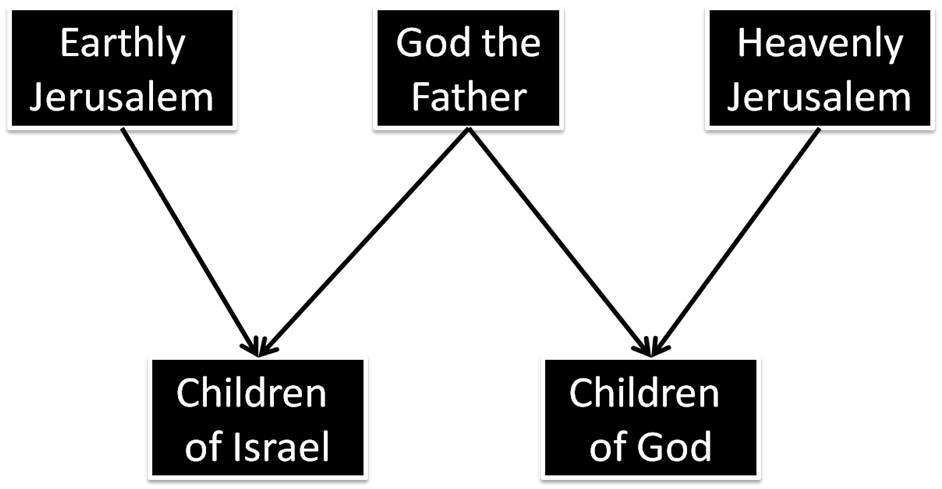
- Being called a child of God and being able to call God – Abba Father was completely new, now that spirit of Christ/holy spirit dwelt within a believer’s heart.
In light of the love of God in our hearts or as John says ‘on account of this fact’:
- The world and its system should not know us experientially because the world does not know God experientially and is at enmity with God;
- The reverse is also true – if we are friends with the world we can’t be called children of God;
- James 4v4 says friendship with the world is enmity with God.
2 Beloved, now we are children of God and not yet Preveal-a what we will be. Moreover, we have Aknown3 that if he (might) Pmanifest-a, we will be like him, because we will MDsee him according as he is.
- Presently we can be children of God but we can also be firstborn sons of God;
- We can be firstborn sons if we are led by spirit of God (no definite article):
For as many as are Pled by spirit of God they are sons of God (Rom 8v14).
- It is not certain what we will be – a child or a son;
- And then there will be different glories between sons (1 Cor 15).
What does ‘if he be manifest’ mean?
- Same as at the end of Ch2 – those who will not see Jesus be manifested because they are not resurrected;
- Every eye will see (Rev 1v7) referring to those on the earth at Jesus’ return;
- If we see Him manifest then the prize is to be resurrected like Jesus and have the life, the age-lasting one.
3 And every(the)one Ahaving this the hope on him, Apurifies himself according as that one is pure.
- The hope is not certain;
- Many teach that the Christian hope of what is to come for a believer is certain. However, it is not certain if a believer will be the bride of Christ;
- Why should we purify ourselves?
- Without holiness it is impossible to see the Lord (Hebs 12v14);
- The Lord is after purity and holiness to count us worthy to be the bride of Christ.
4 Every(the)one Adoing the sin, also Adoes the lawlessness; and the sin is the lawlessness.
- The sin – the sin nature;
- The lawlessness – breaking the laws of God – His standards.
5 And yous have Aknown3 that, that one Pmanifest-a that he might Atake away-a the sins of us; and sin is not in him.
- ‘Known’ here is simply knowledge of;
- Jesus manifested nearly 2,000 years ago but will manifest again in the future (aorist tense);
- Notice the difference in translation:
And you know that He was manifested to take away our sins, and in Him there is no sin. (NKJV)
- To take away versus might take-away-a;
- This verse in NKJV could be taken to mean that Jesus manifested in the past and took away all our past, present and future sin at that point;
- But tying this back to Ch1v7 – it is not certain that your sin will be forgiven and taken away – this has been hidden in this verse – again I think because of theological bias.
6 Every(the)one Aabiding in him Asins not; every(the)one Asinning, has not Aseen him nor has Aknown1 him.
- From v5 – sin is not in Jesus and therefore if we are abiding in Jesus we do not sin;
- ‘Everyone sinning’ – does this verse mean they have never seen him or known him experientially in the past – no, I think it is speaking more of in that moment or in that instance.
 Born2Vision