3 And in this we Aknow1 that we have Aknown1 him (Jesus), if we (might) Akeep the commandments of him.
- Knowing with superscript 1 means to know in an intimate, experiential way;
- The condition ‘to know’ Jesus is keeping His commandments;
- What are the commandments of Jesus?
- Not the Mosaic Law;
- Good place to start is Mat 5,6&7 ‘The Sermon on the Mount’;
- All that is commanded in the New Testament.
4 The one Asaying, “I have Aknown1 him,” and is not Akeeping the commandments of him, liar is and the truth is not in him.

As previously said, this is a test of Fellowship not Redemption.
5 Moreover, whoever might Akeep the word of him, truly the love of God has been MorPcompleted in him. In this we Aknow1 that we are in him.
- The word of Him is essentially the same as His commandments;
- The love of God appears later in 1 John 3&4 so will look at this further in Ch3&4.
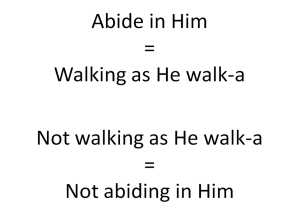
6 The one Asaying, “In him Aabide,” Aought, according as that one Awalk-a, also himself in this way to Awalk.
- Every Christian should be following in the footsteps of Jesus.
7 Brothers, I Awrite no new commandment to yous, but old commandment which yous were Aholding from beginning. The old the commandment is the word which yous Ahear-a from beginning.
- What is beginning in this verse? Notice no article;
- Most likely to be from the beginning of the new covenant but could also be from when they first believed;
- What is the old commandment?
- This is not the commandments from the Old Covenant i.e. the Law of Moses;
- It is the word they heard, are hearing and will hear;
- It is old relative to when John is writing.
What did they hear?
- They heard a new commandment from Jesus but relative to John writing 1 John it is an old commandment.
- The new commandment:
John 13v34 I Agive to yous new commandment that yous might Alove one another as I Alove-a yous, that yous also might Alove one another.
- The Greek word for love in this verse is agapaō which means to love sacrificially;
- Another common word for love in the New Testament, but not used here, is phileō which means to love affectionately, kindly, in a friendly manner;
- This is a commandment which you cannot find in the Old Testament Law;
- Not love your neighbour as yourself which Jesus taught previously but love one another as Jesus love-a them;
- It is the New Covenant Law of Love;
- Jesus not only love-a His disciples as He love-a Himself but love-a them more than Himself;
- How did Jesus love-a His disciples and us?
- He laid down His life for them and us;
- This is why the aorist tense is helpful because when Jesus spoke these words He had not been crucified;
- Christians/Brethren are required to be a living sacrifice and should even be prepared to die for Jesus and the brethren. (They did not love their lives to the death (Rev 12v11));
- Being kind, friendly to other believers is not agapaō-ing them.
Loving your Christian brother or sister is connected to walking in the Spirit. Love is the first fruit of the Spirit listed in Galatians 5v22. To keep this command we need supernatural help – the power of the Holy Spirit.
8 Again, I Awrite new commandment to yous, which is true in him and in yous, because the darkness MorPpasses away and the true the light already Ashines.
- John is now repeating the new commandment which is the old commandment which Jesus gave the apostles;
- He also adds in the contrast of light and darkness.
9 The one Asaying, “In the light am,” and Ahating the brother of him, is in the darkness until now.
10 The one Aloving the brother of him, Aabides in the light and no offense is in him.
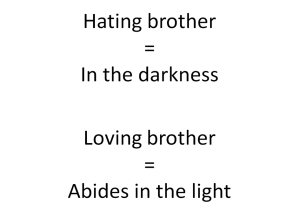
11 Moreover, the one Ahating the brother of him is in the darkness and Awalks in the darkness and has not Aknown3 where he Agoes because the darkness Ablind-a the eyes of him.
- Notice ‘to know’ is superscript 3 – knowledge of;
- Those walking in the darkness are blinded by that darkness and need the light (Jesus, the word, other Christians (Yous are the light of the world)) to help them see.

 Born2Vision