3 that which we have Aseen and we have Aheard we Aproclaim to yous, that yous also might Ahave fellowship with us and moreover (the) our (the) fellowship with the father and with the son of him, Jesus Christ.
- We already know ‘that’ is the light;
- Most translations insert the verb ‘is’ after the 2nd fellowship which changes the meaning slightly;
- I have avoided inserting verbs in my translation which are not in the Greek.
Why is John proclaiming ‘the light’ to his readers?
So that:
- Might have fellowship with them;
- In addition (the) our (the) fellowship with the Father and the Son;
- ‘Our’ may be referring to
- Just John & the apostles or
- John, apostles and the readers;
- ‘Our’ may be referring to
- You need to have the light to have fellowship;
- You cannot have fellowship without following/abiding/walking in the light.
What is Biblical fellowship?
- The share which one has in anything, participation (Thayer’s Greek Lexicon);
- Biblical fellowship with other Christians is not socialising or having social gatherings;
- It is having ‘the light’ and sharing a common life with others in Christ;
- Fellowship vertically and horizontally is necessary in the Christian life;
- As we will see in verse 4 fellowship is necessary for joy.
1st reason John writes is given to us in verse 4:
4 And these things we Awrite to yous, that the joy of yous, having been MorPfulfilled, might be.
What are ‘these things?’
- What John has written in v1-3;
- The light, the word, the life and fellowship;
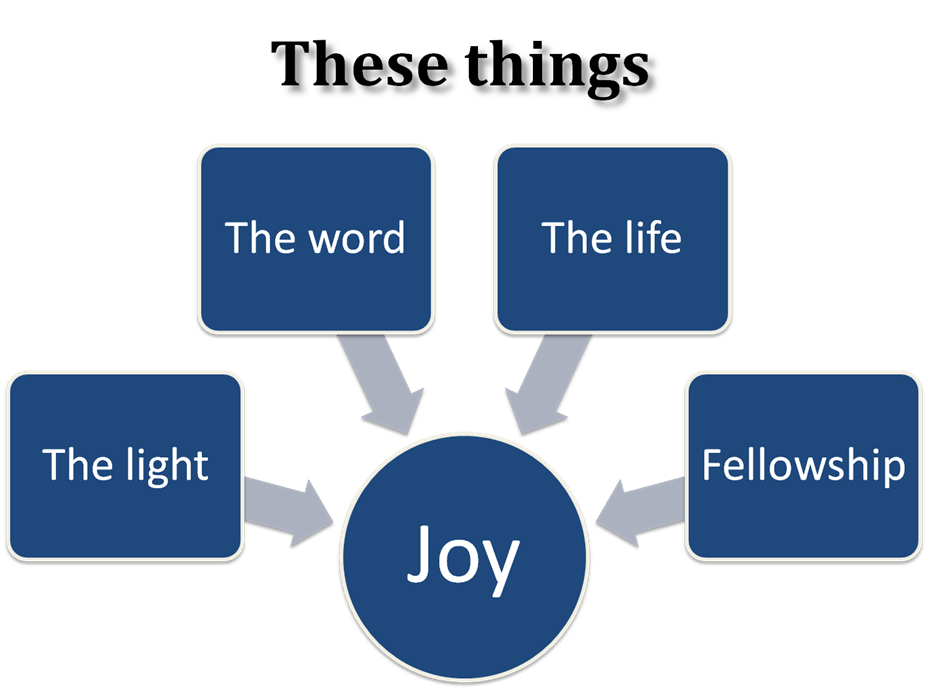
- These themes run through the letter so ‘these things’ would include the rest of the letter too.
Variant reading
- Other Greek manuscripts compared to the Textus Receptus (TR) have a variant reading in this verse:
- Of yous – (your) joy – TR;
- Of us – (our) joy – Other manuscripts;
- Don’t think it matters either way which variant is used – both would be equally valid – simply a copying error.
Translation of verse
- Different than every other English translation which read ‘your/our joy might be full.’
| ἵνα | ἡ χαρὰ | ἡμῶν | ᾖ | πεπληρωμένη |
| that | the joy | of yous | might be | having been fulfilled |
- Having been fulfilled relates back to the noun joy;
- A couple of options:
- That the joy of yous, having been fulfilled, might be.
- That the joy of yous might be, having been fulfilled.
- John cannot be saying your/our joy might be full/fulfilled as in English translations;
- Why?
- John Ch15v11 One word = πληρωθῇ = might be fulfill-a.
- Wuest captures what I believe John is saying in his translation/paraphrase:
- And these things, as for us, we are writing in order that our joy, having been filled completely full in times past may persist in that state of fullness through the present time.
- MorP = Verb could be middle or passive voice as you cannot tell the difference for a Perfect verb.
- May be able to use context to decide;
- However, in John Ch15v11 the aorist verb – might be full/fulfilled is passive so likely the filling/fulfilling is passive in 1 John 1v4.
(Note: So far in my Greek translation endeavours I am unconvinced that ᾖ πεπληρωμένη is a periphrastic construction that can be simplified to ‘might be full/fulfilled.’ In simplifying this phrase it would seem that we are missing some of what the author is communicating, even if it sounds awkward in English.)
4 Questions to ask:
- What is joy?
- When was John’s readers’ joy fulfilled/full?
- Why should a Christian be joyful?
- What are the prerequisites of joy?
1. What is Joy?
- Joy and the verb rejoice appear many times in Scripture;
- Therefore a very important and challenging subject;
- Happiness is not necessarily joy;
- Happiness is dependent on circumstances;
- Biblical joy is a deep and abiding inner rejoicing or gladness and is not necessarily dependent on circumstances.
When was John’s readers’ joy fulfilled/full?
- Important to read and understand John 15,16&17;
- What did Jesus say in the upper room?
John 15v11 These things I have Aspoken to yous that (the) my (the) joy might Aabide-a in yous and the joy of yous might be Pfulfill-a.
- Jesus continues in Ch15 to tell his disciples about the coming of the Holy Spirit;
- Then in Ch16 He tells them a figurative story about the woman who was in labour having sorrow but when the child was born no longer remembers her anguish for joy of the child;
- Jesus was speaking of Himself in this story. He represented the heavenly woman i.e. the heavenly Jerusalem, giving birth to the male child which was the joy sitting before Him (Heb 12v2).
- Then Jesus went on to say these words in His prayer to His Father:
John 17v13 …and these things I Aspeak in the world that they might Ahave (the) my (the) joy, having been MorPfulfilled, in themselves.
- How and when did Jesus give them His joy, once His joy was fulfilled?
- His joy became their joy through the outpouring of His Spirit;
- His joy can become our joy through His Spirit;
- He had to die, give birth to the male-child (His joy and out of which His bride would be formed) and return to the Father so the Spirit could come;
- Neh 8v10 Do not sorrow for the joy of the LORD is your strength;
- It is not our own joy but the LORD’s joy we need to be filled with;
- Joy is the 2nd fruit of the Spirit listed in Galatians Ch5v22.
Why should a Christian be joyful?
- Salvation past (redemption) and the hope of future salvation of the soul;
- So great a salvation (Heb 2v3) compared to OT believers under the law – the Holy Spirit can be in us to help us overcome and thereby inherit the prize of the kingdom of the heavens;
- Psalm 51v12 Restore to me the joy of Your salvation;
- 1 Peter 1v8&9 …Though now Aseeing not, moreover Abelieving, yous MDorPDrejoice with joy inexpressible and having been MorPglorified, Mreceiving the end of the faith of yous-salvation of souls.
What are the prerequisites of joy?
- We do not fill ourselves with joy – the filling is passive;
- Cannot say – today I’m going to be full of joy and do it in my own effort;
- Joy will be a fruit of the Spirit if we do what John says in this letter:
| Walking in the light | Loving God |
| Abiding in the light | Loving your brother |
| Abiding in the love | Doing the will of God |
| Abiding in Jesus | Doing the righteousness |
| Confessing sin | Purifying himself |
| Keeping the commandments of Jesus | Believing in the name of Jesus Christ |
| Keeping the word of Jesus | Guarding yourselves from the idols |
- Many of the above are about how to be and remain in the presence of God;
- Psalm 16v11…in Your Presence is fullness of joy.
5 And this is the message that we have Aheard from him and Atell to yous, that (the) God is light and in him is no darkness at all.
- ‘Heard from him’ = from Jesus – Jesus is the last person mentioned going back to verse 3;
- This hearing also links Jesus to ‘the light’ of verse 1&3;
- The message – (the) God is light and in him is no darkness at all.
What is light?
- Light and darkness in this context are more than physical light and darkness;
- Light is conveying a quality/attribute of God, that He is pure, sinless & holy;
- Darkness being the exact opposite of these attributes.
Backdrop of heresies in John’s day:
- Everything that was matter or physical was evil;
- God did not come in the flesh;
- Jesus was some kind of phantom.
The God is light – theological significance
- If John is saying we saw and heard ‘the light,’ (v1&3) then what he is saying to his readers is we saw and heard God in the flesh because God the Father is light i.e. God the Father shares the same attribute of light with ‘the light’ who was Jesus;
- John is also saying that ‘the light’ who Jesus claimed to be, was God in the flesh;
- Therefore, John was opposing the heresies of his day;
- In John’s gospel he said ‘the word’ was God;
- John 1v1 In beginning was the word and the word was with (the) God and the word was God;
- Jehovah Witnesses – ‘a god’ incorrect;
- No article before the 2nd God but ‘the word’ has all the qualities/attributes of God;
- ‘The word’ was not ‘the God’ – i.e. the Son was not the Father.
- Similarly, in 1 John he is saying ‘the light’ is God;
- 1 John 1v5 is not ‘the God’ is ‘the light’ – the Father is not the Son;
- Importance of putting the definite article in or not;
- It is a way of writing/explaining/emphasizing the three persons of the Trinity in Greek rather than the oneness of the Trinity;
- The Father is distinct from Jesus the Son but both are God as they have the same attributes.
 Born2Vision